Employment History
Work Experience, 2006 – Present

At the end of last year I wrote that 2026 was unlikely to be any better politically. Since then the U.S. and Israel have launched an unspeakably idiotic and morally vile war on Iran. I wrote this month about the lack of a coherent protest movement to the war, and its general absence from day-to-day life.
The large section of the public that opposes Trump and this war are beaten down and burnt out, exhausted after 10 years of relentless right-wing dominance of public life. Many have disengaged from news media, and if they think of the war at all, it is with a mixture of resignation and disgust; a hope that it will end soon, but with little idea of how to bring that about.
I don’t have any more coherent writing on the war as of yet except that everyone involved in the decision to do it is deserving of criminal prosecution. In January I wrote about ICE. Here is an essay about the meaning of work that I have been writing on and off for several years.
2007. I am fifteen or sixteen and work at a cafe above a GAA clubhouse somewhere in posh-ish South Dublin. A man tips me a packet of cigarettes, extracted from the carton he brings back from apartment hunting in Eastern Europe. A woman throws a drink in my face because I brought it to her in a cracked glass. My boss is a nightmare, but this is not her fault. She is an undiagnosed diabetic, and experiencing chronic, severe hyperglycemia. Unbeknownst to us all, we are in the last throes of a period beginning in the mid-nineties where the Irish economy expanded over a precipice in Wile-E-Coyote fashion. I earn the legal minimum wage of €8.65 an hour, which I spend instantly on Friday and Saturday nights on cans of six percent cider, vodka, and cigarettes, occasionally saving €3.50 for a demi-baguette filled with crisps, and a bottle of blue Powerade.
I do not hustle, and I do not grind. I do not build generational wealth. It is extremely unlikely that I will retire early. In Junior Certificate Business Studies – my last interaction with the world of high finance – I received a C. The subject was an unintentionally historical discipline where children in the mid-2000s were taught about even-then ancient practices like Double Entry Bookkeeping. Any trace of that ineffable acquisitive spirit in me was crushed during our school “Young Entrepreneurs” evening. Declining the usual vocations of brownie baking, friendship bracelet weaving, personal portrait creation, or Christmas Card construction, I instead devised an innovative scheme to buy boxes of chocolate muffins through the café supplier at wholesale rates and arbitrage them for double the price to a captive audience of students and parents who had forgotten to eat dinner. My teacher declared it “unfair”, as I had no hand in the creation of said muffins, which were baked by another anonymous node of Capital in an industrial park somewhere in West Dublin. His conception of business was a pleasantly foggy notion of empowered small artisans, competing on an even playing field. As an embryonic Marxist, I knew this to be a fantasy; that there was money to be made for those with the ruthlessness to undercut the hopeless inefficiency of my classmate’s pastries. Having been banned from the school gym, I took my boxes to the car park, where I sold them at a healthy markup to fleeing fathers. Rather than becoming a Randian shut-in and devoting myself to ridding the world of government meddling, my response instead was to declare that I didn’t give a fuck, and that business was for dorks and arseholes. Since then I have never made my money “work” for me. I have only ever worked for it.
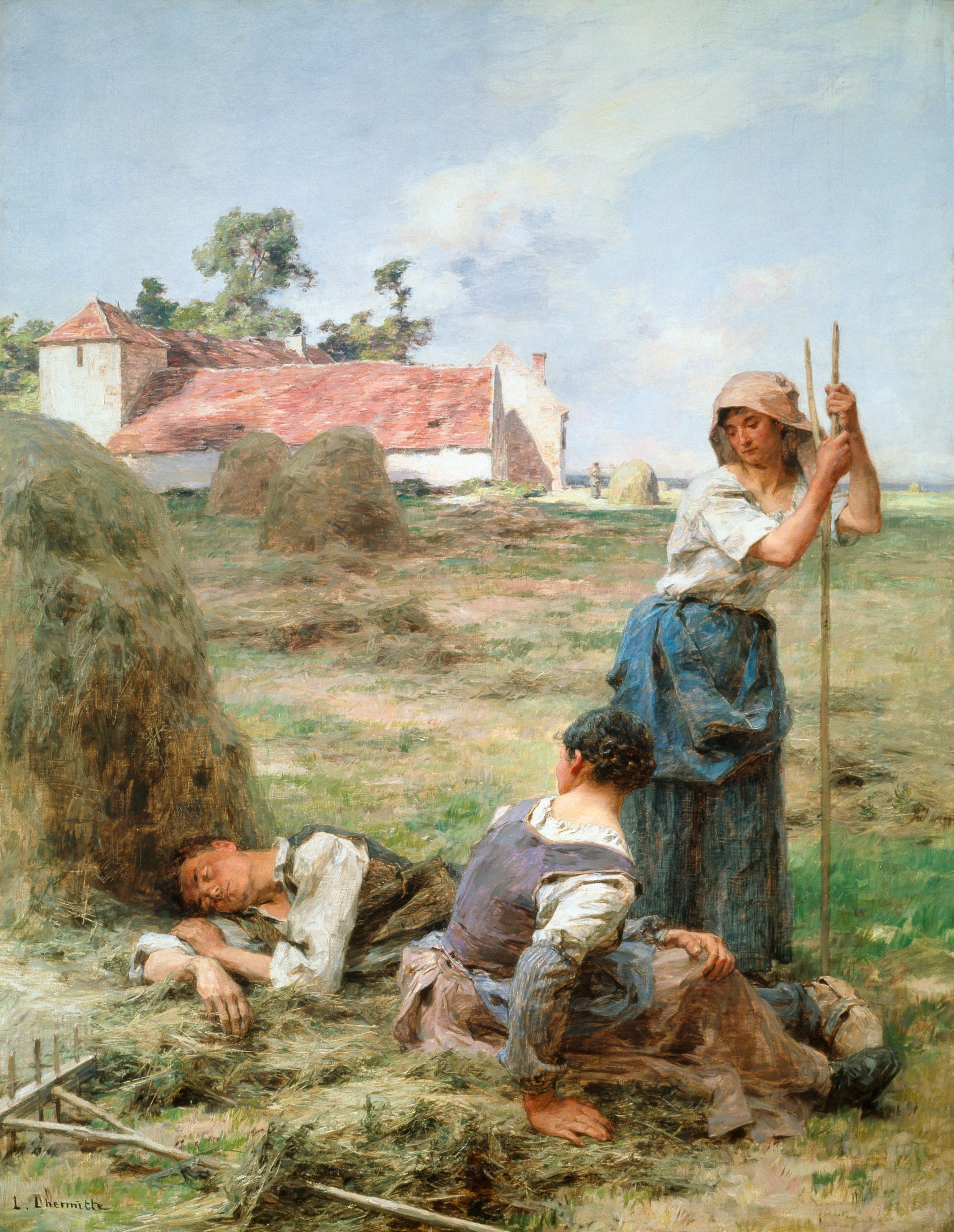
Harvesters at Rest (1888), Léon-Augustin Lhermitte (1844-1925), National Gallery of Ireland, Dublin
2010. I work as a car park attendant at a large hospital during a major renovation, helping the desperate and the irritated find a spot. I overhear myself being referred to one day, not without cause, as a “glorified traffic cone”. I am not permitted to listen to music or read, as that would imperil the already tenuous sense of professionalism of a nineteen-year-old who looks fifteen. There is frequently nothing to do but make laps of the concrete fishbowl and construct elaborate memory castles in my mind. Can you name all the U.S. Presidents in order? I can. This job is where I develop my still-strong fear that I am wasting the priceless minutes of my beautiful life. But you can’t argue with €13.36 an hour, not in an economy where the minimum wage is being cut by over ten percent. The recession is bottoming out, and the government (an official client state of the EU/ECB/IMF 2010 – 13, an unofficial one thereafter) are trying to deliberately lower the standard of living, in an effort to increase Ireland’s competitiveness without devaluing the Euro.
This is not to say that I’ve earned every penny I’ve got, as Nixon once said. I have done lots of degrees and have been the frequent recipient of scholarships, grants, stipends, awards, special awards, bursaries, benefits-in-kind, and even, on rare occasions, an emolument or two. I’m good at filling out forms, good at exams and more than anything, good at recognising which of those will provide maximum remuneration. At its best, this is like temporarily becoming a feckless child of privilege. Rent paid, free dinner in the evenings, a bit of walking around money. But they have a way of leaving you a few Euro short of the basic needs of life. In college, such a thing is contented poverty. After college, such a thing is merely poverty.
2011. I work as a “retail inspector”, travelling the country with my kindly neighbour. He used to play Santa in the local community hall at Christmas, if that gives you any indication of his nature. We are a two-man team, dedicated to removing the scourge of people being served beer underage at off-licences. My unnervingly youthful looks finally pay off as I, now twenty, still look questionable enough to be carded. Those that fail to demand proof in exchange for six Tuborg face the full wrath of whatever organisation I was working for (I never get the name). That is to say, they get retested in six months before they can get full accreditation. I don’t know, I’m the talent, and not privy to all the backroom stuff. Eventually, like a teen starlet, I age out of the profession, and am ushered through the stage door to my own personal Sunset Boulevard.
The Irish economy, an insubstantial mist of property speculation and bad debt, evaporated in 2008/9, leaving behind mass unemployment and even more underemployment. During the years of the bailout – roughly the same as my undergraduate degree – one took whatever work was out there (kids these days etc. etc.). These jobs were not always back-breaking labour, but they were frequently very strange. You might spend a few weeks manning a failing bookshop during its final liquidation sale, serving at a burger restaurant that became a nightclub after ten P.M., or fulfilling some obscure but constitutionally-mandated government duty like guarding ballot boxes overnight. More than one friend worked at a call centre, polling people on how they felt about the government (not good) or trying to get them to participate in a confusing promotion for a multinational dairy corporation. What these jobs shared was the sense (justified or not) that they existed only because no one had gotten around to closing them down yet. They were also determined mostly by who you knew. You could walk around like Yosser Hughes in The Boys from the Blackstuff saying “Giz a job” all you liked, but the most likely place you’d get one was an unlikely personal connection
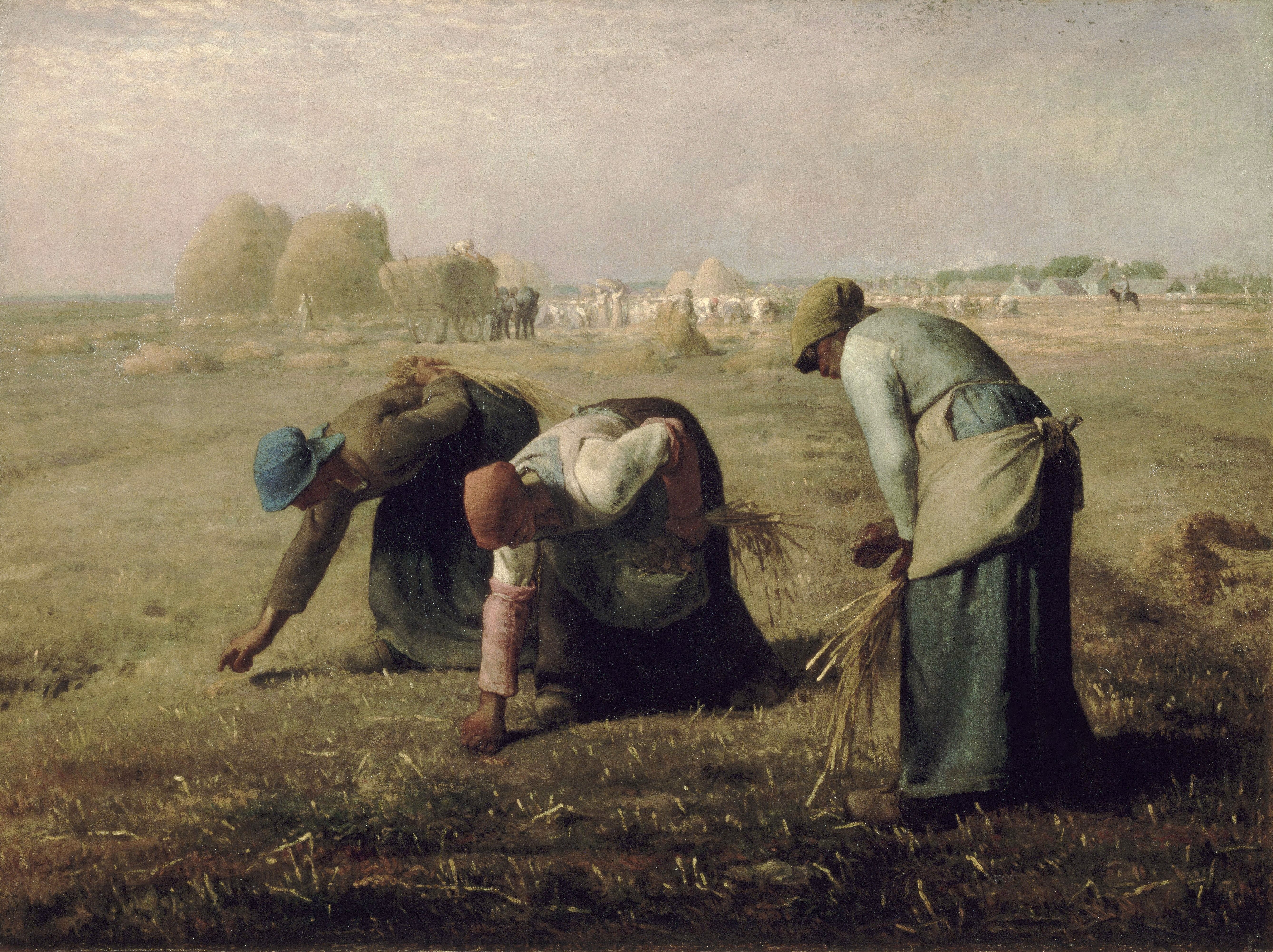
The Gleaners (1857), Jean-François Millet (1814-1875), Musée d’Orsay, Paris
2013. I am a door-to-door fundraiser for a major charity. This is known as charity mugging, or “chugging”, but as I work the neighbourhoods rather than the street, I prefer to think of it as charity home invasion. The summer is a scorcher, the air is fresh, and I get plenty of exercise! This is the worst job I have ever done. It seems obvious in retrospect, but when you knock doors, you knock on every door. If someone is in the habit of answering their door naked (and they are!), you or your unfortunate colleagues are going to see them. You will be propositioned. You will be threatened. You will be called archaic insults that require extensive googling afterwards (jobsworth gurrier shitehawk). You will hear sentences, tossed off in a moment of passionate dislike, that will nonetheless stick with you for decades. But what you will mostly hear is “no”. Hundreds of times a day, thousands of times a week. As the great Gaius Baltar once said, there are limits to the human body, the human mind. One can only take so much rejection before one begins to find the fault within.
The pay is complicated, based on a commission system with targets only achievable by the truly soul-destroyed. It is impossible to maintain a robust sense of self-esteem while wearing a bib. Babies wear bibs, and if they could talk, I have no doubt that they would ask not to. This is one of the few jobs that, by virtue of its truly unbelievable attrition rate, is always available. I am interviewed alongside two others, one in a t-shirt and shorts, the other in a full suit and tie. We are all hired. The t-shirt man lasts two days. The suit does not show up at all. I collapse from heat stroke in Kildare and quit after six weeks as one of the relatively senior members of the team.
In Irish slang, a nixer is a job that pays cash in hand, lasts a few days or weeks, and does not involve interaction with the tax man. This was a far more common way of supporting oneself in the decades before the big boom of the nineties, when Ireland went from a poor country with few jobs to a rich country with many jobs, some of them even real. Ireland in the grinding, recessionary eighties was divided between those in steady careers that allowed one to live some kind of life, maybe a good one, and a large surplus population getting by on a few days a week, a few jobs a month. As a country we, understandably, traded this untenable position for a much more lucrative one as Northern Europe’s top tax haven: a place to park your cash, or perhaps just let it zip through (with a faint whooshing sound) on its way to somewhere else.
2013 (cont.) I work as a tour guide and pub crawl for one among the vast archipelago of phoney businesses that make up most of the Irish tourism industry. The structure is thus: one brave and non-tax compliant entrepreneur stands at the helm of a rickety rust bucket called, let’s say, Diarmuid MacMurrough Tours LLC. Beneath them, a scurvy crew of hungover students, half-dead forty-year-olds and a cabin boy from America lured with the promise of an “internship”. A pay structure that would make a Gilded Age industrialist gasp. Things like Employment Contracts and Revenue Commissioners like dark and dangerous sea monsters, to be avoided at all costs. My job is to deliver the same two-hour walking tour, full of bullshit history and eye-watering jokes, to the unfortunate crowd of people who have accidentally missed the far more popular Sandeman Walking Tours starting location. By night I lead them to many of Dublin’s most anonymous and abominable pubs, to be served shots of whatever has been sitting next to the oven too long. This is truly heart-breaking work: to be a professional friend to the lonely crowds of men and women who could have gone to Barcelona for the same price. At midnight my watch ends, and I make up some almost plausible excuse to leave. Over a two-year period I have, perhaps, one hundred “girlfriend’s birthdays” that I must show face at. What a pity. What a shame. We were having such a nice time, too.
Jobs, jobs, so many jobs! The protagonist of Bruce Springsteen’s Downbound Train has three jobs in as many verses, but nothing on me. And what did I do in between? Endless rounds of education, some of it satisfying, most of it completed, none of it vocational, as such. I’ve always faintly distrusted the word “career”. I’m not really against having one on principle, it’s just that growing up in Ireland’s largely fake economy, careers always took on a sort of unreality to me. People would tell you about a wonderful new position at a start-up and you’d wonder, how does that make a profit? Most of the time of course, it didn’t. But the mid-2010s were the age of free money, especially in an economy as exposed to global capital flows as Ireland. This was a time when there was no idea so dumb that you couldn’t be the brand manager at the Dublin office and get free donuts on Fridays. It was hard not to subscribe to a kind of vulgar Graeberism when the country was so chock-full of bullshit jobs. This was also when my mother held a sunny optimism about my employment possibilities. There is no job for which I was unqualified, from actuarial statistician to Prime Minister of Latvia, that my mother could hear about and not turn to me and say, “Would you think about doing a job like that?”
2014. I work as the Events Intern at a mid-sized LGBTQ rights non-profit in San Francisco. The organisation is one woman’s vanity project, a gigantic pinkwashing operation for fossil fuel companies, financial services firms, and media conglomerates. The focus is on equality in the workplace, so of course the office is an absurd cauldron of sexual harassment cases and illicit affairs. I am sexually harassed by two separate people senior to me in the organisation, one of whom is responsible for whether I get a contract extension. I do not. At Christmas, the CEO forces all employees to sing a version of Feliz Navidad with her name replacing a key word. At $36k a year, this remains the most I am paid for almost a decade.
In my confused class position (most people in Ireland have a confused class position, blame the English) perhaps it flattered my self perception to only take jobs that paid total shit, to remind myself that I was not workshy, not afraid of hard work, wouldn’t turn my nose up at a job. But at the same time, any one of these jobs were disposable at a few days’ notice. You can’t say take this career and shove it. There are few factories in Ireland; we are a postcolonial nation whose industrial capacity was intentionally suppressed. The working class have long been, relative to the rest of Europe, in the service industry, in precarious work, underemployed. Before call centres and fast food emporia, a disproportionate number of Irish people worked in domestic service; hired help in the houses and estates of the landed gentry and merchant bourgeoisie. Before “zero hours” contracts existed, some nascent form of them filled the pockets of our petty capitalists. Today, much of our low-paid, low-status, repetitive, work happens in tourism; to feed the insatiable hunger of our local bosses for American dollars. All that effortless charm and magical blarney is built on the unseen labour of hundreds of thousands of workers. We smile, joke, bow and scrape for the fat wallets of the world’s wealthy. Some of this work has become so mechanized that it has taken on a sort of Fordist quality. At the entrance to the Guinness Storehouse, the citadel of Irish tourism, a facsimile of the original 9000-year lease signed by Arthur Guinness in 1759 sits in the floor beneath thick glass. Every five minutes, a real human being repeats the same 90-second introduction word-for-word to a new tour group. Five minutes a cycle. Twelve times an hour. Eighty four times a day. 1848 times a month. Two hundred decades of the rosary said for Ireland’s most famous capitalist, so celebrated they made a Netflix series about him.
2017. I work as the “Social Programme Manager” at an English language school. I am back to being a professional friend, being mostly responsible for making sure no poor befuddled Italian boy gets hit by a car crossing the street, and ferrying groups to Dublin’s underwhelming tourist sites. The job is almost inhumanly easy, with a repetitive rhythm that slowly wears a groove into my brain. I visit the Guinness Storehouse thirty-three times. Near a personal breaking point, I implement a blanket ban on the playing of Despacito and Zombie in the student room that is also my office. At the end of my first year, I receive a two percent raise. My boss, a not unkind person, shrugs slightly when I question it. What did I expect?
The work varied, but the jobs shared one essential quality: they lacked dignity. They involved, like all alienated labour, some form of self-abasement, large or small, for the simple necessity of making the money needed to survive. In industries where little physical is produced, what the job requires of you is mostly performance. You must pretend to your boss that you are busily typing away even when no work remains. The rich visitor must look at you and see a busy, bright young man! And you must grin shyly back and say something like, no rest for the wicked! These are the lower rungs of our economy. At the higher levels, no real work is being produced either, but it is more excitingly not produced, with many meetings, much strategy, copious slide decks, and a great post on LinkedIn to finish. Ireland’s teeny-tiny corporate tax rates and succession of pliant governments are the reason that international capital is there, not any special qualities you might possess, but that doesn’t mean you can’t congratulate yourself on a job well done!
2018. I begin four and a half years of a “fully funded” PhD programme. The inverted commas are there because full funding, in this case, comes to approximately seventeen thousand euro a year, or considerably less than minimum wage. This brings a different kind of humiliation, a different flavour of alienation. The work is long and solitary but offers occasional cloudbreaks; moments of discovery that would almost certainly be denied me in most better paid work. PhDs are the preserve now mostly of the unfortunate and the wealthy; the indebted or the tourist. The first hurdle in trying to improve the appalling pay and conditions is to convince people that a PhD is a job. It is sometimes difficult to convince the PhD researchers themselves of this.
But surely, you say, writing is a career? Theoretically, anything is a career, but until you start regularly making your rent with it, calling it one feels somewhat overoptimistic, like declaring yourself CEO at Me on LinkedIn. I am additionally unconvinced that my writing, or anyone’s writing, is making much of a difference in halting the many catastrophes that unfold around us, like bats at dusk. I write my little essays, my little stories, my little reviews. Mostly, mercifully, I am paid. Sometimes a few hundred people read them, occasionally tens of thousands. The net effect of either is more negligible than you would imagine. The few times that work of mine has reached a wider audience and provoked a few thousand responses has, frankly, made me deeply uncomfortable and paid precisely the same. But though I might doubt the effect of my writing on the world, I can’t deny the effect it has on me. I am not a tortured writer and I do not hate most of what I write. It gives me immense joy to do this craft to the standard that I can. I feel like a contented baker or a respected carpenter. Not a genius, but equal to the task. Not bored. Not wasted. A friend once told me that a piece I wrote made their father mad for weeks. He would refer to it repeatedly at mealtimes, shaking his head and saying who does he think he is. The memory, even now, makes me smile.
2019. For three blessed weeks I teach nine to five at a program for bright, kind kids. The course I design is a smash success, and every day is as memorable as a prizefight. To expect this kind of work your whole life would be absurd.
I am a qualified academic. What is an academic, you ask? Not what it used to be. The ever-widening gap between the number of PhDs and the number of jobs in the humanities has turned academia from a professional career with a long lead time into something that resembles an extremely expensive version of moving from your one-horse town in Iowa to Hollywood in order to “make it”. You are somewhat more likely to become a successful musician than a tenure-track professor, and you can get a very nice guitar for a fraction of the price of tuition. I dream of a steady gig at a local college, perhaps of being one of a handful to open up a new History department. But while plenty of new History is being made, there are no new History departments. This is a tragedy of course, but ours is a time of tragedies, and this would not make the top thousand. The places where the over-educated left wing used to comfortably hide in the twentieth century have virtually withered away. It has become increasingly difficult to find a niche where you can live a decent life in sympathy with the dispossessed. There is little practical use for sympathy anymore, and it feels as if one must choose between abandoning the dispossessed or accepting your place as one of them.
For the last three years I have worked as a middle school history teacher. Middle school, a division which does not exist in Ireland, is perhaps the least glamorous of all the educational positions. Those who teach younger kids often have a beatific charm, like Ms. Honey from Matilda. High school teachers have fragile gravitas, and the sense that they are preparing young adults for the excitement of university. Middle school teachers, in my experience, are friendly, forgiving, slightly rumpled, and possessed of a gentle, empathetic realism about humanity, born of dealing with the very worst ages of life.
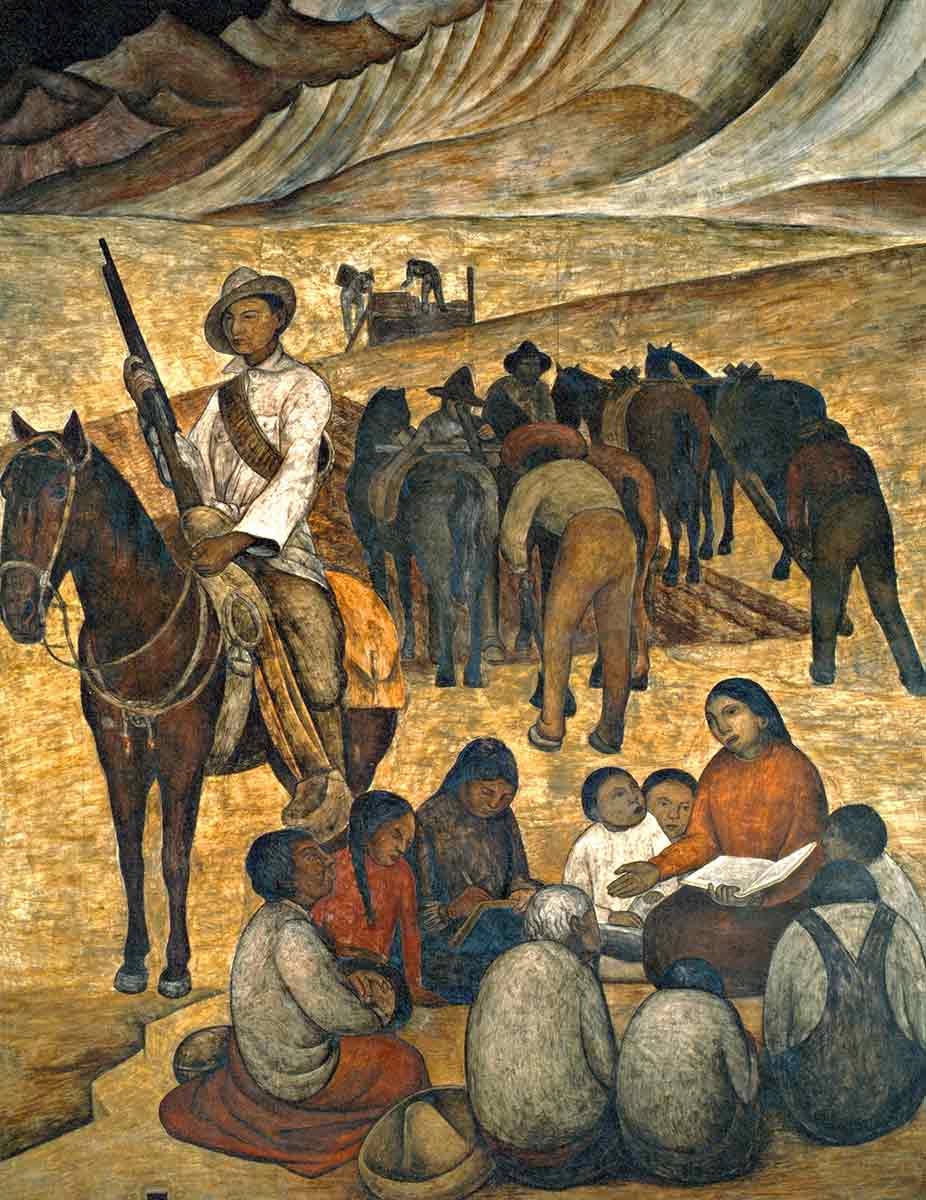
La Maestra Rural, The Rural Teacher (1923), Diego Rivera (1886–1957), Museo Vivo del Muralismo, Secretaría de Educación Pública, CDMX
Teaching as a profession occupies a (say it with me) strange class position, especially in the U.S. Teachers in some states and some schools can earn salaries above 100k, at the midpoint of a solid career. In others, teaching is an effectively proletarianized occupation, requiring a level of self-sacrifice on par with care work or emergency medicine. Teachers’ unions tend toward the most radical among the shrinking base of organized labour. Several of the leaders of the 1916 Rising were teachers, even. In a classical division of society they tend to get lumped in with doctors and lawyers, but without their glamour, or predilection for reactionary politics. Teachers in fiction are put-upon working stiffs, inspirational mavericks, or, in an earlier and more condescending mould, disappointed ladies who have been left on the shelf. My own teachers in secondary school were a strange and very human mix: working class intellectuals, broken-down Christian Brothers, the first ones to attend university from rural farming families, die-hard Irish Republicans, artists whose careers had stalled. Those who can’t do, teach goes the old George Bernard Shaw insult. I have found it to be quite the opposite: teaching requires a set of skills and patiences never even attempted by many supposed “doers”. Teachers were over-represented among 19th and 20th century nationalists; they tended to be people to build a nation for good and ill. Sometimes this meant the preservation and transmission of history and language, sometimes the expansion of literacy to the masses, sometimes the inculcation of questionable patriotic fervour. I will not deny that I am proud of my accidental profession, even though I teach at the more comfortable, relatively well-remunerated end of the spectrum.
If my resistance to embarking upon a career has always been rooted in the faint sense that most work is essentially fake, the last several years have been ones of the world catching up to this idea. We are repeatedly bombarded with the notion that the advent of Large Language Model tools and what is tendentiously called artificial intelligence will rapidly and irrevocably make large swathes of the white collar workforce obsolete, their day-to-day labour replaced by a machine that will email itself with the indefatigability and usefulness of the bewitched brooms of the Sorcerer’s Apprentice. Ironically, all this talk of people’s disposability has made me soften on the value of what are scornfully referred to as “email jobs”.
It probably goes without saying that I loathe AI “writing” tools with every bit of myself, and I totally refuse to use them in either my professional or personal life. If I am to be replaced, I will not go willingly, and neither should you. My instinct is to tell you to go down like John Henry and his hammer or General Ludd smashing the stocking machine. To blacken their name. To kick up a fuss if forced to engage. To complain, defame, refuse. This is reasonable advice, but it concedes too much ground already. The steam hammer that replaced the mythical Henry was at least capable of doing the actual work effectively. As of right now, LLM tools produce endless streams of sloppy bullshit, useful mostly as a pretext for disciplining organized (or disorganized) labour power rather than an actual replacement for meaningful work. We must continue to insist on the value of humanity and human action, in the face of overwhelming propaganda to the contrary. We must believe that humanity can and will continue to revere learning, art, and the thumbprints in the clay that tell you that a person was here, once.
During periods of precarious or non-existent employment, people will often ask which jobs you are applying for, or sometimes more directly, what you want. What I want is probably what you want: to not be broke, to do something with meaning, even small meaning, to reclaim some dignity without becoming so far removed that I forget that such indignity exists. Our current ruling class, head-sick on their own power and impunity, are striving every day to destroy that meaning and dignity. I write and I teach until I am exhausted. Meaning is generated, however distantly. Dignity is present, however variably. As a citizen of the empire of the global north I am part of so many systems of horror, but there are still some that I can refuse.
Barbara Ehrenreich, the late scholar of what it means to be poor, was an exemplar of this. She was keenly aware of the advantages of her own position, but did not indulge in some useless, self-serving guilt. Nor did she lose faith, and collapse into a late, nihilistic compromise with capital that ignored any complicity. Instead, she tried, repeatedly, to find some way to live a life in alliance with those denied dignity. A life of trying does not seem so bad. A life of teaching others to try sounds yet better. What else, after all, am I qualified to do?
Thanks for reading! I had a very similar conversation with an academic before my PhD but, unfortunately or fortunately, ignored it!
As one of those kids from 2019, that course changed my life in a hundred different ways. It remains the most engaging and mind-expanding classroom experience of my life, and I can definitely say my taste in music is a direct result of those classes. Thank you for teaching us like adults, and for showing me a world of ideas outside of the Leaving Cert cycle. Also, ‘Oh I’m A Good Old Rebel’ remains a banger.