Goodbye to Old Gav
The 2025 Irish Presidential Election

I’ve had a quiet few months, writing-wise, but LitHub did republish one of my essays on Palestine. Elsewhere, I wrote a long feature on three types of anti-republicanism for a very handsome new Irish magazine called An Clogán, which you can find in several good Irish bookshops or for sale here. The list of contributors is seriously impressive, especially for a new publication, and the issue is excellent. I’ve been writing a lot of fiction recently, and am considering posting some of it here. Let me know in the comments if that’s of interest! First though, I wrote about the Irish presidential race, which concludes this week. Enjoy!
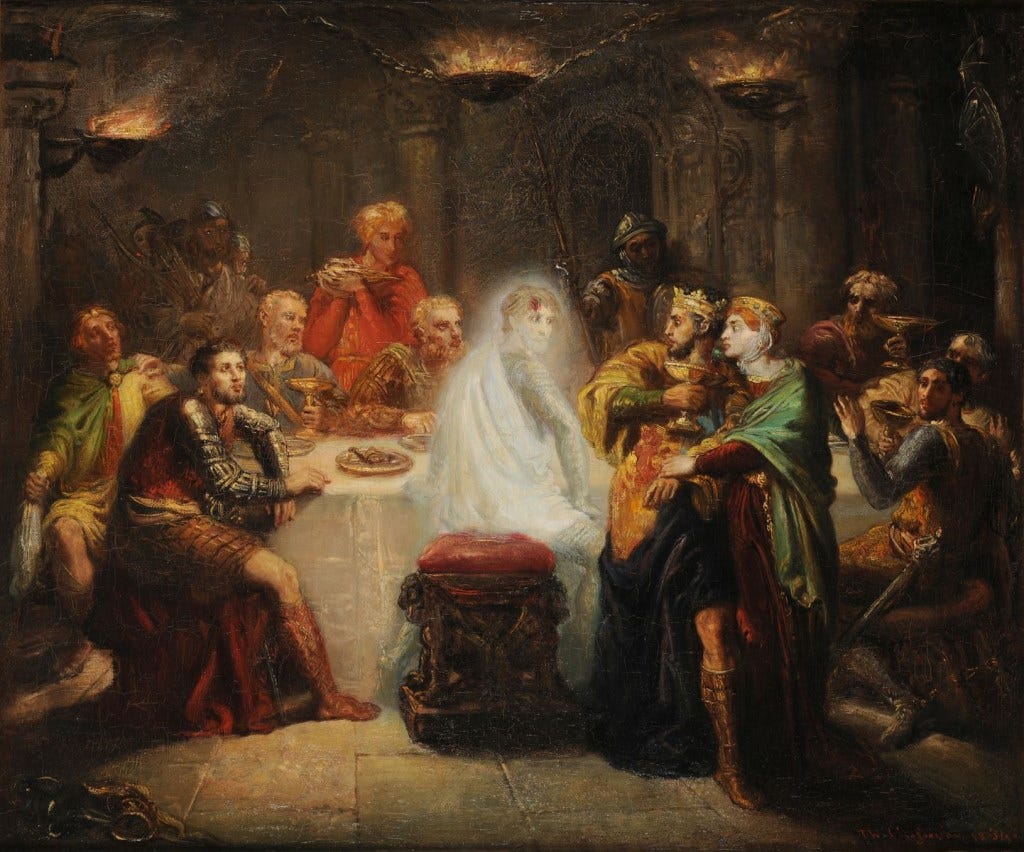
- Théodore Chassériau, Banquo’s Ghost, 1854
Goodbye to Old Gav
Jim Gavin was not going to be president. Fianna Fáil’s nominee for the 2025 Irish presidential election entered the race as an also-ran. Most polls taken before he dropped out had him a distant third of three, on around 15% of the vote. Even prior to his premature departure, he had been foundering, rudderless, unable to answer simple questions, and clearly out of his depth. So why on earth was he there in the first place? The three candidates initially nominated – Gavin, Fine Gael’s Heather Humphreys and the united left candidate Catherine Connolly, all have historical precedents in presidential elections past. Understanding them requires going back to some of those odd, and oddly consequential races.
What the Irish president is and does is a matter of some ongoing debate. The resident of Áras an Uachtaráin is the head of state, an office established in 1937 to replace the loathed and ludicrous Governor General position, a bitter remainder of the incomplete separation from Britain. The president holds mostly symbolic power, with a few official constitutional functions that crop up every once in a while.
The office is taken seriously by the people of Ireland, despite the lack of executive power. People are not voting for their material interests here, except in the most obscure sense. Instead, every seven years the nation is asked what story it wishes to tell about itself. This is not to say that material forces play no part – quite the contrary – but merely that they are more deep rooted, less directly transactional, and more ideologically shaped than a typical Dáil race. Narratives play a much larger role than they ordinarily would. These narratives do not always comport with social or political reality, and frequently a majority of the Irish people vote for an ideology they would not support if it had any chance of actually changing things. Nonetheless, these votes are not entirely symbolic; certain things can be learned from the results.
Tides of History
There have been nine presidents since 1937. The socially conservative, big-tent Fianna Fáil party won every contested election until 1990. From the 1930s through the 2000s they were the natural party of government, and possessed of a legendary voter mobilization machine. They were also often smart about picking consensus figures; respectable old politicians and those more upright than the rest of the party. The strength of their core vote, and the story that Fianna Fáil told, was enough to win for decades, even if barely at times.
Fine Gael have never won a single race. The closest they ever came was with Tom O’Higgins, a liberal in a hidebound conservative party who ran a fairly energetic campaign in 1966, coming within a few thousand votes of dethroning an octogenarian, nearly blind Eamon De Valera. Attempting gamely to replicate the glamour of JFK and Camelot, O’Higgins correctly identified that the ground had shifted under the conservative republican consensus, but was still a few years too early to claim the spoils.
Labour have a strangely good record for such an enduring basket case of a party. If Catherine Connolly prevails, she will be the third Labour-endorsed candidate to become president. Their successful picks have come from the ideological fringes of the party, or, in the case of Connolly, a reluctant endorsement of someone who left the fold almost two decades ago. Connolly’s nomination was initially backed by People Before Profit, the Social Democrats and other independent left and small parties, before Labour (somewhat reluctantly), the Greens and finally Sinn Féin wisely decided to support her. Successfully picking a winner tends to give parties a little fillip in the polls; backing a loser can be catastrophic.
Every presidential election is a wonderful opportunity for some candidates to profoundly embarrass themselves, and for at least one party to spectacularly misjudge the mood of the electorate. Despite Fianna Fáil’s catastrophic collapse and their own commanding presence in government, Gay Mitchell in 2011 delivered Fine Gael’s worst ever performance, with a scarcely believable 6.4% of the vote. Despite his working class upbringing, Mitchell was parodically stiff, humourless, and patrician; the George H.W. Bush of Inchicore. A long-time TD and MEP, he had an eeyore-like countenance and a brittle, combative style that did not endear him to the general public. At one point he suggested Ireland might rejoin the British Commonwealth. When told he was virtually without support outside of Dublin, he donned some approximation of a country squire’s outfit and posed next to a tractor.
Liadh Ní Riada’s decision to challenge Michael D. Higgins for reelection in 2018 made a certain amount of sense if you squinted. Sinn Féin were attempting to build on their strong 2016 general election performance and boost the profile of one of their rising stars. Instead, she was swallowed up in that year’s clown car of also-rans, netting even fewer votes than Mitchell had seven years before.
She was not the funniest or most humiliated candidate that year, however. That prize goes to Dragon’s Den star Gavin Duffy. Duffy is what passes for a successful businessman in Ireland, that is to say someone who attends many dinners, vaguely consults on a variety of nebulous subjects like leadership and change, and carries an air of faint but persistent malfeasance, like the smell of mildew in a shower curtain. His campaign (2.2%) came to an end during a radio interview, during which, when pressed, he could not precisely recall the number of people he had hit with his car in a long career of hitting people with cars.
Given their lack of executive power, there is frequently a disconnect between the rhetoric of the president and the actions of the government in power. Unlike the strange ritual of Britain’s yearly King’s or Queen’s speech, the Irish government does not directly put words into the mouth of the head of state. They are nonetheless expected to avoid direct confrontation, though near misses occur fairly frequently these days. An early harbinger of the current era was a 1976 controversy that prematurely ended the tenure of President Cearbhall Ó Dálaigh. Ó Dálaigh was something of a maverick: an urbane, activist Supreme Court justice with a particular zeal for preventing government overreach in matters of individual judicial rights. He was elevated to the presidency without a contest on the sudden death of Erskine Childers. He had the misfortune to be president at the same time as the blighted Cosgrave administration, then flailing in response to the ongoing crisis in the north and introducing some of the most draconian public order law in Irish history. When Ó Dálaigh took legitimate issue with the emergency legislation Cosgrave’s government was attempting to pass, referring it to the Supreme Court, he was called a “thundering disgrace” by Minister for Defence Paddy Donegan, the most reactionary of Cosgrave’s band. Donegan, a man who was once convicted of firing a shotgun over a halting site in an attempt to intimidate Traveller people out of their homes, should have been forced to resign. Cosgrave circled the wagons, however, making Ó Dálaigh’s resignation inevitable. He was replaced by Patrick Hillary, a man whose Brezhnevian pair of terms was distinguished only by his laudable refusal to allow the office to become yet another instrument of his increasingly grubby and corrupt political party.
Ó Dálaigh, like Tom O’Higgins, was ahead of his time. Mary Robinson in her 1990 campaign explicitly argued that the role of the president should become more expansive, and won a mandate to make it so. She was a frequent headache for the government of the day, and was on one occasion constitutionally prevented from leaving the country by a Fianna Fáil administration worried that she would draw attention to the state’s many failings in front of world media. Robinson broke from the Irish political establishment in openly meeting with Republicans like Gerry Adams, as well as Unionists. In this she prefigured her successor’s stated dedication to “building bridges” in Irish society, even with people who were persona non grata in establishment political circles.
The Oracle at Delphi Adventure Centre
Presidential elections are frequently early heralds of the next decade, such that the occupant of the Aras often fits better the longer they are in the job. Mary Robinson won fewer first preference votes than Fianna Fáil’s Brian Lenihan, but was helped by her opponent’s disastrous campaign, including a major corruption scandal and a legendary comment from Padraig Flynn about her “new hairdo” and “new-found interest in the family”. Lenihan was ultimately undone by his role as a Fianna Fáil enforcer, something which would echo twenty years later in the campaign of Seán Gallagher.
Robinson was running at the end of a deeply reactionary decade, which had seen legislative and even constitutional losses to a resurgent and vicious right. Her victory was an indication that Ireland’s conservative majority was now a rapidly dying plurality, and the country was building a socially liberal population block that would eventually claim every major party. By the end of her tenure, homosexuality, divorce, and contraception had been decriminalised. Abortion would have to wait another two decades.
Mary McAleese in ‘97 was another candidate who caught the moment about as well as any Irish politician ever has. A lawyer and academic, McAleese was a northern Catholic who as a child had been forced out of her home by loyalist pogroms. McAleese was a deeply committed Christian who nonetheless broke decisively with the Catholic hierarchy over their handling of the abuse scandals, and her personal commitment to religious plurality. Her mantra of “building bridges” was often understood simply as being about reaching out to northern unionists, but McAleese’s ecumenism was wider than that. More controversial among the Irish establishment was McAleese’s commitment to extending the hand to northern republican politicians, including those involved in paramilitary activities. The bridges went both directions. With hindsight, the early 90s commitment to treating Gerry Adams and Sinn Féin as untouchables that required a cordon sanitaire seems utterly ludicrous, and both Robinson and McAleese were vindicated in ignoring their critics.
During the grim years of the Fine Gael-Labour coalition (2011–16), the Labour Party as junior governing partner were responsible for executing some of the most brutal austerity in Irish history. They did so with initial reluctance, genuine or feigned, before settling into the usual posture of decayed European social democratic parties: a haughty, paternalistic self-satisfaction. When passing a savage 30% cut in unemployment relief for young people, a Labour TD claimed that they were doing it to incentivise access to work and training, saving the youth from the scourge of “watching a flat screen TV seven days a week.” Michael D. Higgins had spent his life in the Labour party, and in the early days of his presidency it was common to see him rightly and eloquently advocating on behalf of the very people they were immiserating. In the 2016 general election, Labour were obliterated. Higgins’ popularity continued to climb to giddy heights. His reelection in 2018 was comfortable, proving only the relative softness of Sinn Féin’s core support and a murky, rising reactionary current that drove Peter Casey to over 20% of the vote.
Throw Away Your Television
Michael D. Higgins’ victory in 2011 came during an exceptionally bleak period in Irish life. The country had surrendered sovereignty to the EC/ECB/IMF troika the previous year, and Fianna Fáil had been so thoroughly discredited that they didn’t even field a candidate. And yet, they still almost won. The Celtic Tiger was dead, the country was mired in depression, and the old order was washing away. The narrative was there for the taking. As such, the field of candidates was large. The campaign was full of scandals, and extraordinary, consequential, even questionable interventions from the media. During this crisis the already permeable walls between journalist, politician and activist broke down. The enormous malfeasance of Irish and international banks took some investigation, and journalists at home and abroad were developing an inflated sense of their own world-historical importance. The previous year, journalist George Lee spent a disastrous nine months as an elected Fine Gael TD. Fianna Fáil tried unsuccessfully to recruit broadcaster Gay Byrne as their candidate. Journalist Niall O’Dowd was seriously floated as an option by more than one party. In a live TV debate, presenter Miriam O’Callaghan, never a paragon of impartiality, asked Sinn Féin candidate Martin McGuinness the question, “How do you square, Martin McGuinness, with your God the fact that you were involved in the murder of so many people?”
The race came down to Higgins and Séan Gallagher, yet another businessman, yet another Dragon’s Den judge. They charted very different courses out of the depths. Higgins, a sociologist by trade, spent his career on the left wing of the not very left Labour party, and had cultivated an internationalist and third worldist sensibility, forging links with Latin American socialists and offering stark criticism of the United States, Israel, and NATO. His other great love was for the arts. The story he told was one of a new, more socially conscious Ireland, moving away from the crass and often criminal materialism of the Celtic Tiger years, and towards something more humane and meaningful.
Gallagher was, like so many 21st century politicians, a reality TV personality. His life was a textbook example of the essential fictionality of many business careers. A few years of spottily successful business-owning, supported by generous grants and loans from governmental bodies, becomes a narrative of bootstraps and entrepreneurial derring-do. This reputation established, and burnished by prizes and places on magazine lists, it is then leveraged into positions on boards, lucrative media opportunities, and consulting work, which requires nothing more than a suit, tie, and copy of PowerPoint. Gallagher offered an image of Ireland’s future that almost put him in office: bombastic, cheery optimism, and a sense that we could all get back on our feet if we just displayed a little more of that can-do Irish spirit that had lifted us out of the bog. Ireland would bounce back by being the best little country in the world at doing business.
Gallagher was polling at 40% going into the final debate, ten points clear of Higgins with only a few days until the election. Under RTÉ studio lights he was confronted with the unmistakable odour of his past. Gallagher had admitted to being of the “Fianna Fáil gene pool” but professed to leaving the party before all the worst chaos descended. In front of an audience of almost a million people, his campaign unravelled, as Martin McGuinness and presenter Pat Kenny tore into him about his suspicious business dealings, and deep connections to the Fianna Fáil machine. In a sensationally lurid moment, McGuinness accused Gallagher of acting as a facilitator and courier for the sort of brown envelopes and backhanders culture that had defined the party since at least the 1980s. Banquo’s ghost appeared in the form of a Dundalk fuel smuggler. Gallagher later successfully sued RTÉ for their perceived unfairness, but the damage was done. A radio interview the next day made things considerably worse. Like Lenihan, he was now known countrywide as a Fianna Fáil “bagman”. Regardless of any possible illegality, it was clear that Gallagher represented the old order in everything but name. He came a distant second on election day, and an even more distant fourth seven years later. The window of opportunity for blithe, amnesiac business boosterism in the Áras had closed. Blithe, amnesiac business boosterism would stay where it belonged: in the Dáil and the Department of An Taoiseach.
The Ghosts at the Feast
On the right and in the centre, the 2025 election is notable more for its absences than its presences. On the extreme, rapist and far-right ethnonationalist Conor McGregor failed to get a nomination, running a fairly inept operation that mostly consisted of wearing ill-fitting suits and making garbled, xenophobic twitter videos. Peter Casey, a right wing – say it with me – former Dragon’s Den presenter, who won 23% of the vote in 2018, also fell short of the support needed to get on the ballot. Most prominently, and ominously, Maria Steen, best known for her involvement with the Iona Institute, a Catholic anti-choice organization, made a late, and near-successful tilt at getting nominated, falling short by just two sponsors. Steen’s candidacy would have likely absorbed and amplified the energy on the right. We will never know how many votes a social conservative would have netted in this election, and how her presence would have changed the tone of the debate, thank Christ. A right wing candidate, however, will almost certainly be competitive in 2032.
There are two candidates from establishment parties who could have won this election who are not on the debate stage: Mairead McGuinness and Micheál Martin. McGuinness, initially the front-runner and only Fine Gael candidate, was forced to withdraw for health reasons. A centre-right religious conservative and EU power broker, she was probably closer than any other Irish politician to real executive power, and I do not mean that as a compliment. Her appeal to the Irish people would have been about competence, which is a word that the media and political class use for how well one adheres to the whims of the European Commission and international capital at any given moment.
Micheál Martin, on the other hand, could have won on the back of his enduring popularity among broad swathes of the country, even if not within his own party. Rumours of his entry to the race swirled early this year, before he ruled himself out during the summer. Calling him the most high profile Fianna Fail member is a severe understatement. He has, over the last decade and a half, essentially monopolised the party, and he has been allowed to as long as his personal popularity still comfortably outstripped that of the brand itself. Fianna Fáil still carries the taint of incompetence and corruption to those of age during the recession, but Martin escapes it. This is highly ironic, considering that he himself is the last holdover of the Ahern/Cowen governments. Nonetheless, he has spent years as Ireland’s most popular party leader. His party colleagues, on the other hand, have never been seen, and little is known about them. It is theorized that there are other political personalities in Fianna Fáil, but there is no way of knowing this for sure.
Ultimately, Martin was unwilling to relinquish real power for a comfy seat in the Áras, but given his role in pushing the nomination of Jim Gavin, he might find himself without either. A poll released this week found that the Gavin affair dealt the party, and Martin a serious blow. His personal favourability rating fell by eleven points, with the combined Fianna Fáil/Fine Gael vote at or near its lowest level ever. Rumours of heaves against Martin are like rainshowers: they come, and they go. There is always discontent within the party, but until a credible candidate emerges, the near-fifteen year reign of Martin will continue.
Both McGuinness and Martin would have been, essentially, EU candidates. The message of their presidencies would have been something like, Ireland needs to grow up, and move closer to its western allies. Get real about defence spending, the triple lock mechanism, participation in EU military exercises, even membership of NATO. Facilitators of a giant “national conversation” about neutrality with one predetermined result: handing over billions to armaments companies. Jim Gavin, handpicked by Martin, expressed a single policy preference, which was “reform” of the triple lock. Humphreys, if elected, may attempt something similar, but lacks the harder edges of either Martin or McGuinness. The best that could be said of her is that she does not have the cold fish anti-charisma of some of Fine Gael’s previous candidates, but it would be hard to point to anything approaching a vision of moral leadership.
So why Jim Gavin? Gavin himself may now be asking that question. The former Irish Air Corps pilot and successful Dublin GAA manager was parachuted in from nowhere, without a sniff of a previous political career. He made a series of minor gaffes, performed one step above appallingly in a televised debate, and generally exhibited the charisma of someone working at the Car Tax office. There was an essential pointlessness to the Gavin campaign. All presidential campaigns run on platitudes, given the limitations of the office, but Gavin’s were particularly platitudinous, and not delivered with the customary panache. He heralded nothing, neither a break from the past nor continuity. The scandal that finally brought him down was petty, but revelatory. He had held on to money accidentally paid to him by a former tenant. The amount in question was a few thousand, like the amount in the envelope that Gallagher was accused of handing over. The stink of malfeasance, of small-time double-dealing was unmistakable, because Irish people have decades of experience with it, both personally and politically. Most people have had a landlord like Gavin.
“Smear the bejaysus out of her”
The race is in its dying days. From seven candidates in 2011, and six in 2018, we now have only two. Heather Humphreys is spending the final stretch making inane videos of herself drinking coffee and being sued for defamation. Catherine Connolly, on the other hand, has been the subject of relentless attacks from media and political figures, but weathered them surprisingly easily. Former Fine Gael minister and failed bookie Ivan Yates said the quiet part loud when he advised the party to “smear the bejaysus out of her”. Fine Gael and Fianna Fáil have evidently taken him at his word, accelerating their smears in the closing hours. Fine Gael produced an American-style attack ad which has even their own backbenchers shifting uncomfortably in their seats. This pattern of increasing mania as the day draws near is familiar to anyone who has watched Irish elections, but usually directed at Sinn Féin.
Like Robinson and McAleese before her, the insinuation is that Connolly is too radical, too close to republicanism, too sceptical of the bellicose militarism of power brokers in Europe and the U.S. That she will in some way embarrass us in front of the Germans, or the Americans. In this I believe they have misjudged the sympathies of a majority of Irish voters, who like an independent, critical voice, and do not, by and large, yearn desperately for ever closer military and political integration with our gallant allies in the “West”. Social media is alive with indignation about the apparent closing of ranks in the media against Connolly.
The presidency has been occupied by a person of the left or centre left for, remarkably, my entire life. Thirty five years of leaders with drive and purpose. Robinson’s of a reinvigorated Irish feminism, and a commitment to human rights abroad. McAleese’s of reconciliation between divided communities on the island. Michael D. Higgins has provided a steady, intelligent, humane voice on the moral and political questions of the last fourteen years. It’s possible to draw a coherent line from Robinson and McAleese through Higgins to Connolly, just as the comparisons between the venal grubbiness of Lenihan, Gallagher, and Gavin are unavoidable. Humphreys is just the latest in a string of subpar Fine Gael candidates.
Should Connolly triumph on October 24th, as the polls currently predict, it would be an impressive victory for an Irish left that has managed to display coherence and unity unthinkable even a few years ago. If they can hold this kind of message discipline in a general election, the possibility of Ireland’s first government without Fianna Fáil or Fine Gael feels, at last, possible. Connolly has managed to position herself effectively as both the heir to Higgins and someone who can go beyond his legacy. She has spent a lifetime as a principled, independent-minded voice on the left, with ironclad commitments to the rights of the most vulnerable, and a refusal to accept the polite fictions of the political centre and right. If Ireland is to take a more critical and clear-eyed look at its place in the world, Connolly is by far the best placed to facilitate it.
The world is in a wretched place, and sorely in need of humane leadership. Liberal institutions have been seriously discredited by their silence or active complicity in the Gaza genocide. This moment feels uncertain, unmoored, full of possibility and risk. We’ve been fortunate in our heads of state over the last three decades, with some genuinely close calls. Ireland deserves better than reality TV stars or Fine Gael and Fianna Fáil castoffs. The country does not need seven years of a pliant president, a mouthpiece for the government of the day who will do little but attend ribbon cuttings and sign on the dotted line. Europe needs politicians who will engage with the EU not as an altar to genuflect to, but a real power structure to be engaged both critically and constructively. The world needs humanitarians, negotiators, people who will stand up for peace when every person in the room is demanding war. Catherine Connolly is the only candidate not speaking in meaningless bromides, the only one offering a real vision, the only real choice.
Another great article Jack although you may have to engage a number of lawyers to fend off claims of libel, bias and other forms of attack by people who don't like the truth.
Keep away from the fiction though - your forte is the daily truth