All for Palestine
Hope in a hopeless time.

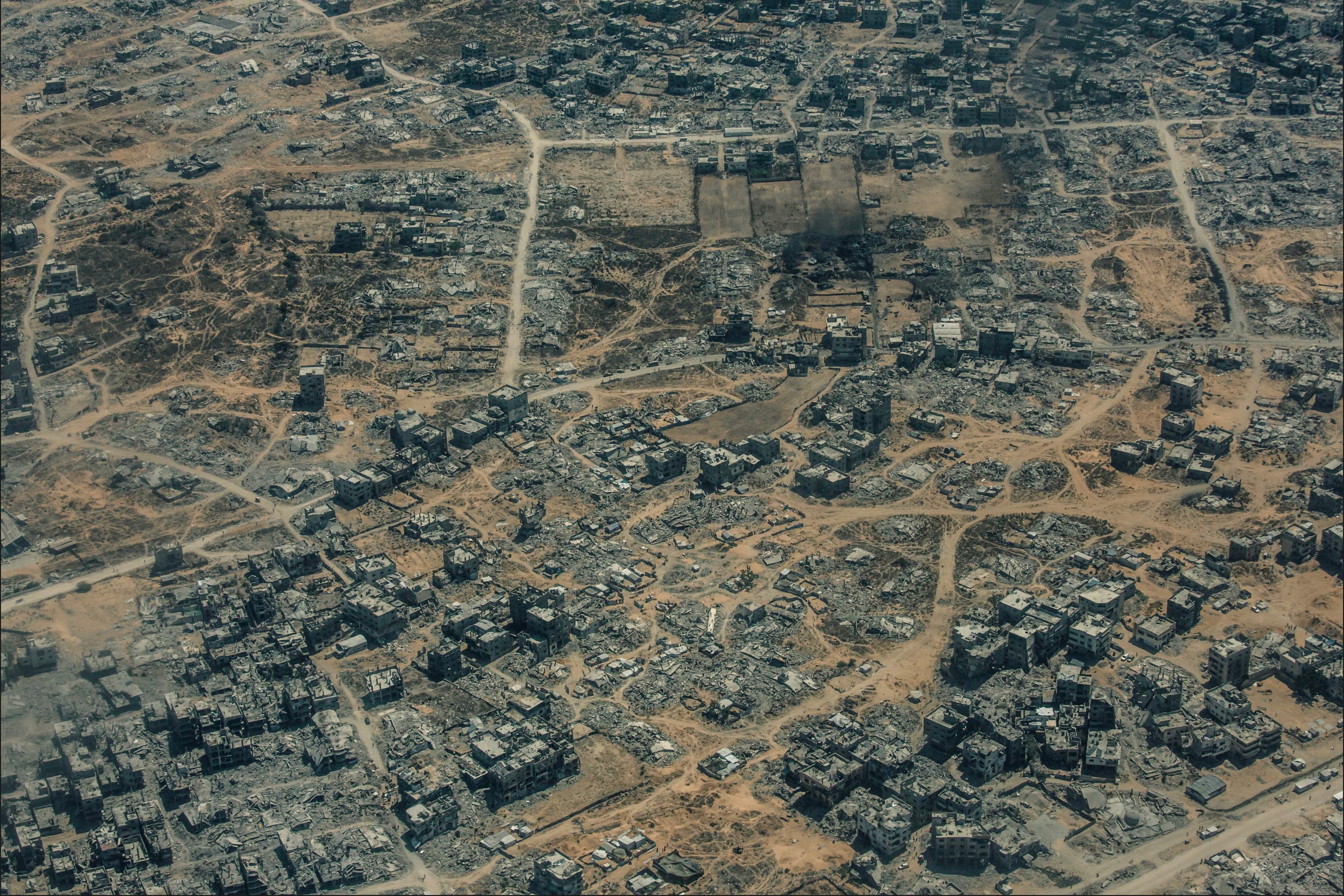
Gaza, August 2025 (Alessio Mamo/The Guardian)
Move him into the sun–
Gently its touch awoke him once,
At home, whispering of fields unseen.
Always it woke him, even in France,
Until this morning and this snow.
If anything might rouse him now
The kind old sun will know.
Think how it wakes the seeds—
Woke once the clays of a cold star.
Are limbs, so dear-achieved, are sides
Full-nerved, still warm, too hard to stir?
Was it for this the clay grew tall?
—O what made fatuous sunbeams toil
To break earth's sleep at all?
– Wilfred Owen (1893 – 1918), Futility, May 1918
It has never been worse than this. The last time I wrote here of Palestine, in February 2024, the invasion of Rafah – Joe Biden’s supposed red line – had just begun. Since then the IDF has obliterated Rafah, along with most of the rest of Gaza. Tens of thousands of Palestinians officially, hundreds of thousands in all likelihood, have been killed, by Israeli bombs, bullets, and starvation. The long-threatened famine is here. Hundreds have already died of starvation. More than a thousand people queuing for food have been gunned down in two months. The West Bank, without even the pretext of a Hamas presence, is under a state of dual siege. The IDF executes urban destruction, killings and kidnappings, while a juiced up army of settlers spread terror among the Palestinian population, vandalizing, looting, burning, and murdering, knowing the police, army and courts are on their side. All the while Israeli politicians and media figures have ceased to hide their intentions whatsoever. Seemingly every day brings another quote, each one gobsmacking in its genocidal intent, from a politician quoting Hitler as a model for what should be done, to the Finance Minister’s repeated demands for ethnic cleansing and settlement of Gaza.
Horror of this scale has the effect of deadening words, making stories of the most unimaginable violence land with a dull thud. We are used to it, even as new levels of depravity are found weekly. I have seen every one of the most obscene images of violence of my life in the last two years. As teenagers we would see images like this very occasionally, either intentionally or accidentally. Moments of surreal and genuine violence, usually culled from video nasties like Faces of Death, old VHS transfers of 35mm film further pixelated into short animated GIFs. Now, new high-fidelity snuff films are created daily, and we see them in our Instagram feeds next to pictures of holidays and ads for Volvos. Ash and fire and endless grey dusty death. Not that it’s anywhere near the most important thing to think about, but this daily bombardment of images of death is having a devastating psychological effect on everyone who experiences it.
All of this has been said before, by better writers than me. And yet it’s worth saying it again. The deliberate policy of the Israeli government is to flood the world with so many crimes that it becomes almost impossible to hold on to any one for any length of time. As Nemick says in the first series of Andor, it’s easier to hide behind forty atrocities than one single incident. I might have been embarrassed once to quote a Star Wars character, now I find I don’t much care where I get my encouragement from.1 Why be embarrassed about anything else, when the whole world is party to an obscenity that shames us all?
The last two years have been clarifying, and not only in unpleasant ways. I feel an immense sense of kinship when I see some visible act of solidarity for Palestine, no matter how minor. At a check up this month, my doctor wore a keffiyeh pin, and I had a glimpse of what it might have been like to be an abolitionist in the early 19th Century, seeing someone else wearing a badge that said, “Am I not a man and a brother?” The left is notoriously fond of factionalism and infighting and yet I feel absolutely no desire to rehash old battles now. What do I care if someone is a social democrat or a communist, an anarchist or a left liberal, if they are willing to stand with me on this, the moral crisis of our lifetimes? Friends I haven’t spoken to in years share the same horror, reach out for a quick word. I feel as if we are part of something greater than ourselves. Perhaps something too little too late, but that is not yet decided.
Many of the old certainties that I felt in earlier years have faded away. As a lifelong agnostic, I find more kinship among people of faith who oppose this war than fellow non-believers who stay silent. There is even some solace to be found in religious texts, even if I can’t quite get myself to believe them. Not a man ordinarily given to quoting the bible, I found myself struck by a colleague’s deeply moving presentation on a verse from, of all things, the Old Testament. This document, so often a justification for violence, also contains words of reconciliation, of fortitude and healing. I will take my encouragement where I can get it.
“...and people will call you Repairer of Broken Walls, Restorer of Streets to Live in.”
– Isaiah 58:12
I have seen some laughable commentary from the more tedious sections of the British political system wondering indignantly how Palestine became such an important issue, lamenting people’s relative lack of fervour for more quotidian domestic problems. They are missing the point spectacularly. This attempted destruction of the Palestinian people is the great moral issue of the early 21st century precisely because it is being done in our names. It is a demand to kneel in the face of brutal, arbitrary power, lest it be turned against you next. If it is not refused, if it is not defeated, if it is not at least battled to a standstill, I do not wish to contemplate what comes after.
This crisis has shown us which world leaders are truly beneath contempt - most of them. Which ones – Biden, Trump, Starmer, Merz, Macron et all – will not only consent to this genocide but brutally discipline their populations for having the gall to question it. And question it they are. The mass mobilizations for Palestine have been among the largest in history. They have also, so far, been ineffective in exerting power. That is no slight whatsoever on the activists, among whose ranks I’d count myself, for whatever minor amount I’ve done. It is merely an acknowledgment of the immense democratic chasm in the world of 2025: little that we do or say seems to have any effect on the actions of our governments or the international organizations to which they are a part. It’s also to acknowledge the incredible social, economic and physical violence meted out against those opposing this slaughter. In country after country the full repressive apparatus has been deployed to ruin the lives of anyone who dares to speak out.
Almost 20 years ago the Irish political scientist Peter Mair coined the phrase “ruling the void” to describe the creation in the west of a democracy stripped of its demos, the removal of democratic control over vital economic and political functions, alongside the encouragement of mass indifference among the general population while power continues to be exercised in their name. Western nations are no longer merely ruling the void, but ruling a moral abyss: using the withered consent of the populations of Europe, the US, Canada, and Australia to facilitate Israel’s genocide.
The justifications for the slaughter which started out so white hot after October 7th have cooled now. As they have moved further and further from the original pretext they have also become more and more incoherent. The hostages are used only as the bluntest tool. They can only be invoked against anyone seeking a ceasefire, never analysed or examined. Even their families must be eliminated from the popular discourse if they threaten the needs of the Israeli government. The many thousands of Palestinians (including children) held hostage in Israeli internment camps are, of course, not a consideration whatsoever. Listen to Israelis politicians, ambassadors, online influencers or their supporters online and you’ll hear the same phrases repeated ad nauseam. Hamas must surrender, Israel does not commit war crimes, Hamas steals aid, the UN refuses to distribute aid, the IDF only fires warning shots at civilians, the people you see wasting away were sick or disabled anyway. Those videos are fake. Israel has the right to exist. Do you condemn Hamas? Why aren’t you out marching against Hamas? This criticism, that criticism, all criticism of Israel is anti-semitism.
If there seems to be no consistency to any of this, that’s because there isn’t. The goal is not to convince you, those days are long gone. The goal is to muddy the waters and make you switch off. Failing that, to batter you into submission, to convince you that Israel’s power and control is so great that it cannot be faced, and must only be endured or endorsed.
And yet, and yet, and yet, I cannot give up the feeling, the hope, that gradually, things are changing. The hollowing out of democracy in the west is profound, but it is surely not yet at the point where leaders are simply immune to the wishes of their constituents. Across Europe’s largest countries, fewer than a fifth of people hold a favourable opinion of Israel. The comments section of the New York Times, once the natural home of blithe, unexamined liberal Zionism, now abounds with people calling for a total suspension of military aid and diplomatic cover.
It’s easy to feel powerless and alone, bombarded by so much indifference and sick glee from those who do not care, or who approve. But it's worth remembering that most people, when presented with images of immense and deliberately inflicted human suffering, have a human response. They are against it. They are revolted by it. They want it to stop. The question is not opinion but salience. How can we transform the issue from being one in which people passively feel opposition to one where people are activated, and motivated to exercise their vote, their boycott, their feet to do something about it? How can we mobilize people in sufficient numbers, and effective ways, as to be impossible to ignore? How can we make it clear to our political class that this is non-negotiable, and that those who facilitate it will be held accountable, in the ballot booth and perhaps the court room too. How can we bring pressure on Israel that is not only moral, but backed by real political and economic force?
Because the notion that we are powerless, that there is nothing that we can do, is an admission of pessimism that the powerful in Israel would love to encourage. If there is nothing that can be done to stop them, then there is no limit to what Israel can do. But there are limits, and there are tools at our disposal. Israel is not immune to pressure. They are, of course, sustained by military aid and sales from the U.S. and Europe, but they also have an economy that is deeply integrated into that of the world. This is not some autarkist hermit kingdom, it is a modern state reliant on foreign investment and trade, and whose non-Palestinian citizens are accustomed not only to a high standard of living, but the freedom to travel worldwide, frequently visa-free. As a pseudo-European state on the periphery of the continent, Israel is deeply connected to many European organizations, from education to entertainment. There are pressure points everywhere if governments can be forced to use them. It will require creativity, flexibility, and a great deal of humility.
أَيَحْسَبُ ٱلْإِنسَـٰنُ أَلَّن نَّجْمَعَ عِظَامَهُۥ ٣
بَلَىٰ قَـٰدِرِينَ عَلَىٰٓ أَن نُّسَوِّىَ بَنَانَهُۥ ٤
“Do people think we cannot reassemble their bones? Yes indeed! We are most capable of restoring even their very fingertips!”
Qu’ran (75:3-4)
It is time for the international movement for Palestine to go on the offensive. This slaughter must end, this occupation must end. And until it does, we need economic sanctions on the state of Israel, not merely the occupied territories. Arms sales, even of so-called “defensive” weapons, must be cancelled in both directions. This point is even being argued by some in the (admittedly small) Israeli left. As in South Africa in the 1980s, the goal must be to bring some critical mass of Israelis to the table through moral, economic and political force. Some will experience that genuine psychic break with Zionism that many white South Africans did with their country’s system of oppression. Some will move cynically, making the calculation that accommodation with the Palestinian population is preferable to being a permanent international pariah. Both groups will be necessary.
Those responsible for or participating in war crimes must be investigated and charged, including those Western consultants and mercenaries who have enabled the bread massacres in the guise of the “Gaza Humanitarian Foundation”. Driven by intense organizing from the Hind Rajab Foundation and the Global Legal Action Network, Belgium recently detained and interrogated two IDF soldiers accused of war crimes, the first such case in Europe. Ireland is inching closer to banning trade with the occupied territories, and the cross-party Oireachtas committee is pushing back against government attempts to water it down. Slovenia became the first European country to declare a total arms embargo on Israel. In itself this will have little impact, but it is a crack in the dam. It may be that Israel has finally overextended itself. There are signs of frustration with Israel among some EU states which have up to this point cosigned their actions. The French, the Dutch, even the Germans appear to be running out of patience, or fearing electoral backlash. Either way, the lonely corner of Europe that dared to question Israeli policy – Spain, Ireland, Belgium, Slovenia, Norway – looks likely to acquire a few new members. Outside of Europe, the newly formed Hague Group of nations aims to put some institutional heft behind the global movement.
Slowly, haltingly, we move forward. It is, needless to say, maddening to watch powerful people who endorsed this for two years suddenly have a road-to-Damascus moment. Many of these, especially the most senior politicians and media figures, are entirely cynical, an attempt to avoid holding the bag when the absolute worst details come out. Some are partially genuine, experiencing a gradual erosion of long-held Zionism that simply cannot withstand the mounting horror. You are under no obligations to enthusiastically welcome the powerful into a coalition, but we may have to grit our teeth and be patient with ordinary people as they look for a way to assuage their conscience. In late July, centrist independent U.S. Senator Angus King released a startlingly angry statement. Notwithstanding the usual throat clearing, he concluded by saying, “For these reasons, I am through supporting the actions of the current Israeli government and will advocate—and vote—for an end to any United States support whatsoever until there is a demonstrable change in the direction of Israeli policy.” The statement is interesting both in that it comes from someone not on the left, but also appears to skip several expected steps in the ladder of escalation. The promise is not to sanction a handful of settlers, symbolically recognize a Palestinian state, or even to merely restrict arms sales, but to vote for an end to any United States support whatsoever if there is no change. Sometimes when people break, they break hard. Those who have long felt secure in the bipartisan underwriting of Israel’s many crimes may yet feel the ground move under their feet.
The movement builds strength, but the killing continues. So where to look for strength in the meantime? Of all places, the American Civil War is where I have been taking some hope, looking for the ways in which seemingly unassailable systems can be fought. Oliver Wendell Holmes Jr., wounded three times as a Union soldier, recalled that his generation was one whose “hearts were touched with fire”. The brutality of the American Civil War is well established – a war fought with modern weapons and initially pre-modern tactics. The slaughter at Antietam, Shiloh, and Gettysburg was a taste of what the 20th Century would bring. Unlike the First World War, which started for no good reason and was fought for even less, the American Civil War was understood by the most clear eyed Unionists and Confederates to be, from the outset, something titanic and consequential. Even for those in the North who didn’t care a damn for the four million held in brutal bondage, or those who wanted a soft, conciliatory approach, the war began to take on new and moral meaning.
On a thousand small town New England greens,
the old white churches hold their air
of sparse, sincere rebellion; frayed flags
quilt the graveyards of the Grand Army of the Republic.
– Robert Lowell (1917 – 1977), For the Union Dead, 1960
Lincoln is the clearest example of this transformation. Before the war he had been a radical Whig, then a moderate Republican, with relatively humane but unmistakably blinkered and racist mid-19th century liberal views. He was, above all, a believer in the essential goodness and necessity of the United States, a belief that lent him the steel to stand up to the South when they dared him. The experience of secession, of war, of industrial slaughter and gallant sacrifice, of Black soldiery and humanity all reforged Lincoln into a stronger alloy. By war’s end he was not only convinced of the moral rightness of Black suffrage and civil rights, but of their essential necessity and urgency. As Karl Marx wrote to Lincoln in 1864, “If resistance to the Slave Power was the reserved watchword of your first election, the triumphant war cry of your re-election is Death to Slavery.”
Holmes and his generation had “seen with our own eyes, beyond and above the gold fields, the snowy heights of honor”. Their duty was simply to “bear the report to those who come after us.” For a time the American Civil War made hard-bitten soldiers of soft-handed Northern lawyers and merchants, moral giants of former slavery apologists, and heroes of people thought good enough only for the scrapheap. Ulysses S. Grant was a reluctant soldier, a failed businessman, and a bad farmer. He was drummed out of the army for his drinking, and only recalled because the supposed best and brightest military minds had deserted to the Confederacy. His failures did not paralyze him: they freed him. Freed him from ego, from fear, from the inability or unwillingness to act that characterized the early Union generals. I know many activists feel burnt out and broken now, ground down by defeat, despair and repression, by the real consequences they have experienced and the sheer obscenity of the crimes being committed. But in this struggle we may too be remade as something better than we are now.
A ghost that haunts the contemporary left is the feeling that we are, in some fundamental way, unworthy of the legacy of our ancestors. Those women and men who died to end slavery, to win basic rights, to win the vote, to dethrone monarchs and destroy the ancien régime, to fight Czarism and fascism and Nazism and imperialism and apartheid, they were in some way our moral betters. They were braver, they were smarter, they could endure more and keep faith longer. They were not afraid to fail, to lose, to suffer and to perish for these ideals. They believed in something better to be built, we only fear that worse is yet to come. But these people were merely people, just as we are. They did not start out their lives brave, or strong, or fearless. They were transformed by their struggles. They found bravery in each other, they found strength in their work. Their fear was never banished, only mastered.
Radicals around the world rejoiced at Lincoln and his Grand Army of the Republic, the Emancipation Proclamation, the Thirteenth, Fourteenth, and Fifteenth Amendments. Slaves, serfs, peasants, and wage workers mostly understood that what was being struck was a hammer blow on their behalf. The liberation of the Palestinian people would not be the end of something, but the beginning.
How do things change? First slowly, then all at once. Weeks and decades, decades and weeks. We outside of Palestine do not have the luxury of despair. We must keep the faith even when hope seems faint. We must remember that all empires fall eventually. No oppression lasts forever. If we were to do nothing useful for the rest of our days save to hasten the arrival of a free and democratic Palestine, with equal rights for all, ours would be lives worth living.
But grief is not the end of all. I seem to hear the funeral march become a paean. I see beyond the forest the moving banners of a hidden column. Our dead brothers still live for us, and bid us think of life, not death – of life to which in their youth they lent the passion and joy of the spring. As I listen, the great chorus of life and joy begins again, and amid the awful orchestra of seen and unseen powers and destinies of good and evil our trumpets sound once more a note of daring, hope, and will.”
– Oliver Wendell Holmes (1841 – 1935), 1884.
Alex Lawther, the actor who plays Nemick, has been outspoken in his support for Palestine.
Look here, another Irish person with the mantle of humanitarianism, dripping with emotional language so as to unfocus the mind, but having been passively/willingly fed propaganda that seeks to reward Hamas for the monstrosity of October 7. Hamas thanks you, as do all future monsters who invade music festivals and rape civilian women to win over the likes of you. When I see useful idiots like these, I can't help but think a lifetime of euphemisms in "polite" Irish society that shroud anti-Semitism help lubricate the lies they swallow. Why not advocate for an end to the war by telling Hamas to return all of the hostages and lay down arms? I'll answer it for you: You have already given your official Paddystinian seal of moral authority about who gets to live in their homeland, you've chosen the good guys and bad guys, and the saintly children of Éire are never wrong! So your prescriptions all steer in that direction. The smugness and po-faced concern is why the world now sees Ireland as the epicenter of Western anti-Semitism and performative woke irrelevance.